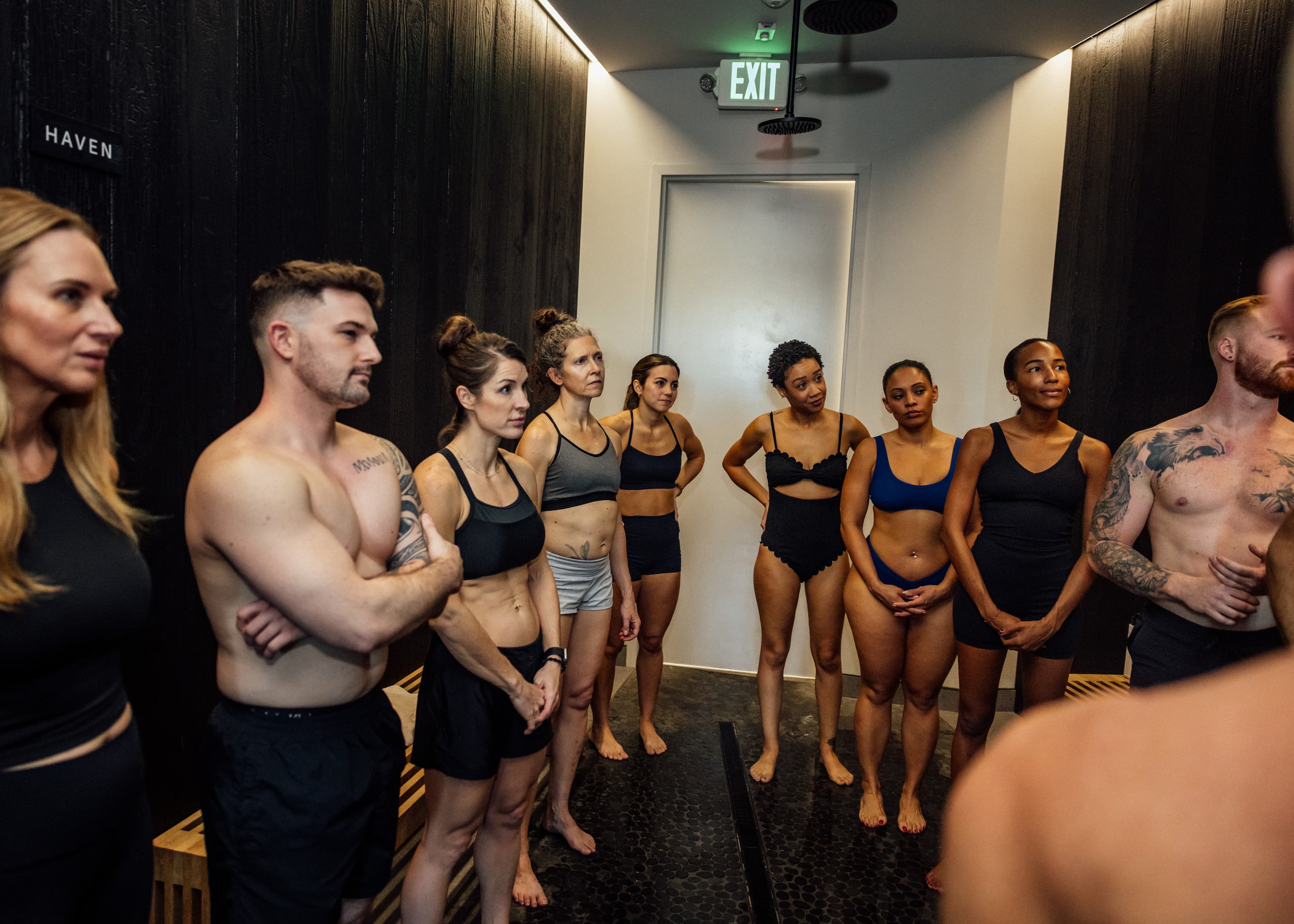
Guided contrast therapy — sauna and cold plunge led by a trained instructor — is one of the fastest-growing corners of wellness. The global sauna market was valued at $859 million and cold plunge at more than $708 million, and studios are opening across North America. But most of them are self-guided: hot room, cold tub, a waiver, and a timer. The studios people return to — and the careers being built right now — center on something different: a trained human leading the room.
If you’re a coach, yoga or meditation teacher, bodyworker, studio owner, or simply someone who keeps finding yourself helping others through the heat and the cold, this guide covers what the work involves, the science you’ll need, and how certification works.
What does a sauna and cold plunge instructor do?
An instructor does far more than watch the clock. In a guided session, the instructor sets the protocol — how long in the heat, how long in the cold plunge or ice bath, and how many rounds — and layers in breathwork, meditation, and facilitated conversation. They watch for safety, adapt for newcomers, and create the conditions for a room of strangers to genuinely connect.
Revivery co-founder Annette Scott calls this the “competent protector” role: keeping everyone safe while knowing when to push, encourage, and guide. That dual responsibility — physiological and relational — is what separates instruction from supervision.
“To guide people, to be their competent protector, to hold space for somebody is a very powerful thing.”
The science you’ll need to know
Credible instruction starts with the physiology. Regular sauna use is associated with improved cardiovascular fitness, lower blood pressure, and lower cholesterol, and frequent use has been linked to a reduction in all-cause mortality. Cold water immersion has been shown to elevate mood, relieve symptoms of depression, and lower stress levels.
An instructor needs to understand the mechanisms behind those findings — heat shock proteins, cardiovascular adaptation, vagal tone, and structured exposure protocols like the Søberg method — well enough to explain them, apply them, and adjust them for the people in the room. But the biology is only the first layer. At Revivery we teach the Bio/Psych/Social Method: the thermal science, the psychological tools (Nonviolent Communication and trauma-informed practice), and the social craft of building connection.
“Not only are you benefiting physically — you’re benefiting psychologically, and you’re most certainly leaving with a social benefit and growth.”
Do you need a sauna and cold plunge certification?
People search for this credential under many names — a cold plunge certificate, a cold water therapy course, sauna instructor training, contrast therapy classes for teachers and coaches. They’re all asking the same question, and the answer starts here: there’s no legal license required to lead sauna and cold plunge in the United States — which is exactly why certification matters. Studios, gyms, and clinics adding contrast therapy need instructors who can demonstrate safety training, a teaching method, and facilitation skill. A serious program should cover thermal physiology, contraindications and emergency response, group facilitation, and supervised practice leading real sessions — not just an online quiz.
The lack of relational training is the gap in most programs. As Annette puts it: “We’re teaching you how to listen with your posture, your words, and your smile, how to reframe a question, and how you listen to the question. All these pieces come together to convey that degree of safety and attention.”
What the training actually feels like
REV-1, the Revivery instructor certification, pairs the Foundations online course — thermal science, trauma-informed communication, group management — with three days in person in Tampa, where you practice leading guided sessions and get direct feedback. Graduates leave with the REV-1 credential and 30 CrossFit CEUs. Cohorts are capped at 28 people, and that room becomes part of the training itself.
“To be able to come into a setting with total strangers and open up and talk about really deep, profound things is a way to heal that I’ve never experienced before. I knew nobody in that room.”
“While you are holding space for others to be vulnerable, they are also holding space for you.”
That experience is the point. You can’t guide people through discomfort you haven’t practiced moving through yourself. Annette frames the outcome this way: “They will gain the ability to teach people that even when they are uncomfortable, they are still safe, capable, and can still problem solve.”
“Everything that you learn within this training is so impactful in everything you do in your life. It changes the lens you’re viewing the world through.”
Who becomes an instructor?
Our cohorts include CrossFit coaches and gym owners, yoga and breathwork teachers, chiropractors and clinicians, studio founders preparing to open, and people who simply felt called to lead this work. No prior wellness certification is required for REV-1. What the paths share is a pull toward holding space for others — and a willingness to be in the heat and the cold yourself.
“Those of us that get called to come here — you obviously have something in you that is meant to be shared.”
Your next step
If this is the work you’re meant to do, the path is straightforward: complete Foundations online, spend three days with a cohort in Tampa, and leave with the credential and the toolkit. Upcoming REV-1 cohorts run October and December.
REV-1 Instructor Training
REV-1 Foundations online + 3-day Tampa immersive. REV-1 credential and 30 CrossFit CEUs. Cohorts of 28.
Choose Your REV-1 Dates