Contrast therapy is booming. Studios are opening across North America, backyard plunges are selling out, and millions of people are discovering what deliberate heat and cold can do. What hasn’t kept pace is safety education — most new practitioners learn protocols from social media, and most new studios hand members a waiver and a timer.
At Revivery we hold one line above all others: safety is non-negotiable. Comfort is not the goal — discomfort is where the adaptation happens — but a session is only as good as the container it happens inside. This guide covers the physiological guardrails we teach every instructor, and why real safety goes well beyond the thermostat.
Sauna and cold plunge temperatures, times, and dosing
The research behind sauna’s benefits — including the landmark Finnish cohort studies linking frequent use to lower all-cause mortality and improved cardiovascular health — was conducted at real heat, used regularly. In our sessions that means a sauna in the range of 174–194°F, with heat rounds of roughly 8 to 11 minutes: long enough to trigger the heat shock protein response, short enough to keep the dose appropriate for a group.
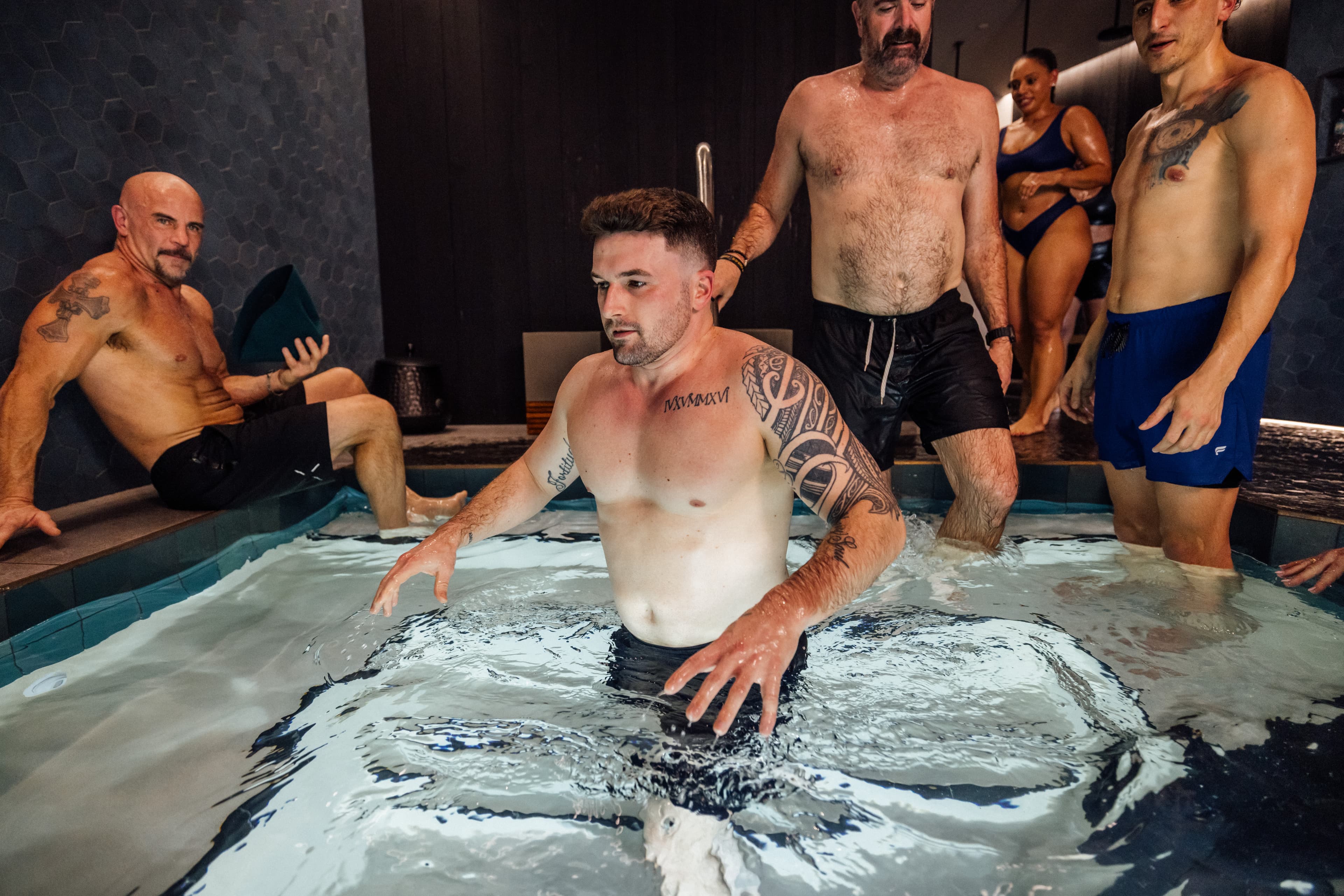
On the cold side, we work between 38 and 55°F, immersed to the back of the neck, for up to three minutes. Colder is not better; longer is not better. The adaptation — the mood lift shown in cold immersion research, the circulatory training of vasoconstriction and vasodilation — comes from repeated, well-dosed exposure, not from heroics.
“Keeping track of time and giving everyone their time in the sauna is what I stressed about most.”
That instructor’s honesty points at something true: structure is a skill. Holding time windows for a room of twelve people with different capacities, while staying present, is one of the five core elements we evaluate in every instructor certified through Revivery Instructor Training.
The cold shock response: the moment that matters most
The highest-stakes seconds in any session are the first seconds of a cold plunge or ice bath. Sudden skin cooling triggers what physiologists call the cold shock response: an involuntary gasp, a spike in heart rate and blood pressure, and uncontrolled rapid breathing. In open water it’s a leading mechanism of drowning. In a studio plunge it’s manageable — but only if the person leading the room knows what they’re looking at.
An instructor watches for gasping and breath-holding, and coaches the breath before and through entry: a long, slow exhale is the lever that brings the response under control. The encouraging news from the research is that the cold shock response habituates quickly with repeated exposure — and that anxiety amplifies it, which means a calm, regulated instructor isn’t a nicety. They’re a physiological intervention.
“To guide people, to be their competent protector, to hold space for somebody is a very powerful thing.”
Who should talk to a doctor first
Contrast therapy is strong medicine, and not for every body in every season. Harvard Health advises that people with uncontrolled high blood pressure or heart disease check with their doctor before sauna use, and clinicians flag recent cardiac events, pregnancy, and conditions that impair sweating or temperature regulation as reasons to get medical guidance first. A trained instructor asks before the first round, not after — and knows that “when in doubt, refer out” is part of the job, not a failure of it.
The same goes for state on the day: alcohol and saunas don’t mix, ever, and a dehydrated or sleep-deprived nervous system has less capacity for the stress the practice deliberately applies. We teach instructors to hydrate rooms before, during, and after — water plus electrolytes — because an hour of heat and cold moves serious fluid.
Safety is more than physiology
Here’s what the protocol sheets miss: every nervous system that walks into a sauna is silently asking one question — am I safe here? The answer isn’t delivered by the thermostat. It’s delivered by the person leading the room: their steadiness, their voice, the way the space was prepared before anyone arrived.
This is why we train instructors as what Annette Scott, Revivery co-founder, calls the competent protector — someone with the qualities of a great parent, who keeps everyone safe but knows when to push, encourage, and guide.
“They will gain the ability to teach people that even when they are uncomfortable, they are still safe, capable, and can still problem solve.”
That sentence is the whole philosophy of safe contrast therapy in miniature. The heat and the cold are supposed to be uncomfortable — that’s the training stimulus, for the body and for the nervous system. The instructor’s job is to make sure discomfort never becomes danger, physically or emotionally. It’s the difference between a hard thing done alone and a hard thing done held — and it’s why the Bio/Psych/Social Method treats the room’s emotional safety as rigorously as its temperatures.
The short version
Real heat, well-dosed: 174–194°F, 8–11 minutes. Real cold, well-dosed: 38–55°F, up to three minutes, exhale first. Hydrate with electrolytes. No alcohol. Know who needs a doctor’s clearance. Watch the breath at every plunge entry. And remember that the most important safety equipment in the room is a regulated, trained human — because the sauna and the cold are the capsule, and connection is the medicine.
Learn to hold the room
REV-1 teaches the science, the safety protocols, and the facilitation craft of guided contrast therapy. REV-1 Foundations online + 3 days in Tampa. 30 CrossFit CEUs.
Choose Your REV-1 DatesThis article is educational and isn’t medical advice. If you have a health condition, talk with your doctor before starting sauna or cold plunge practice. Instructor quotes are from RIT graduate surveys and interviews, lightly edited for clarity.