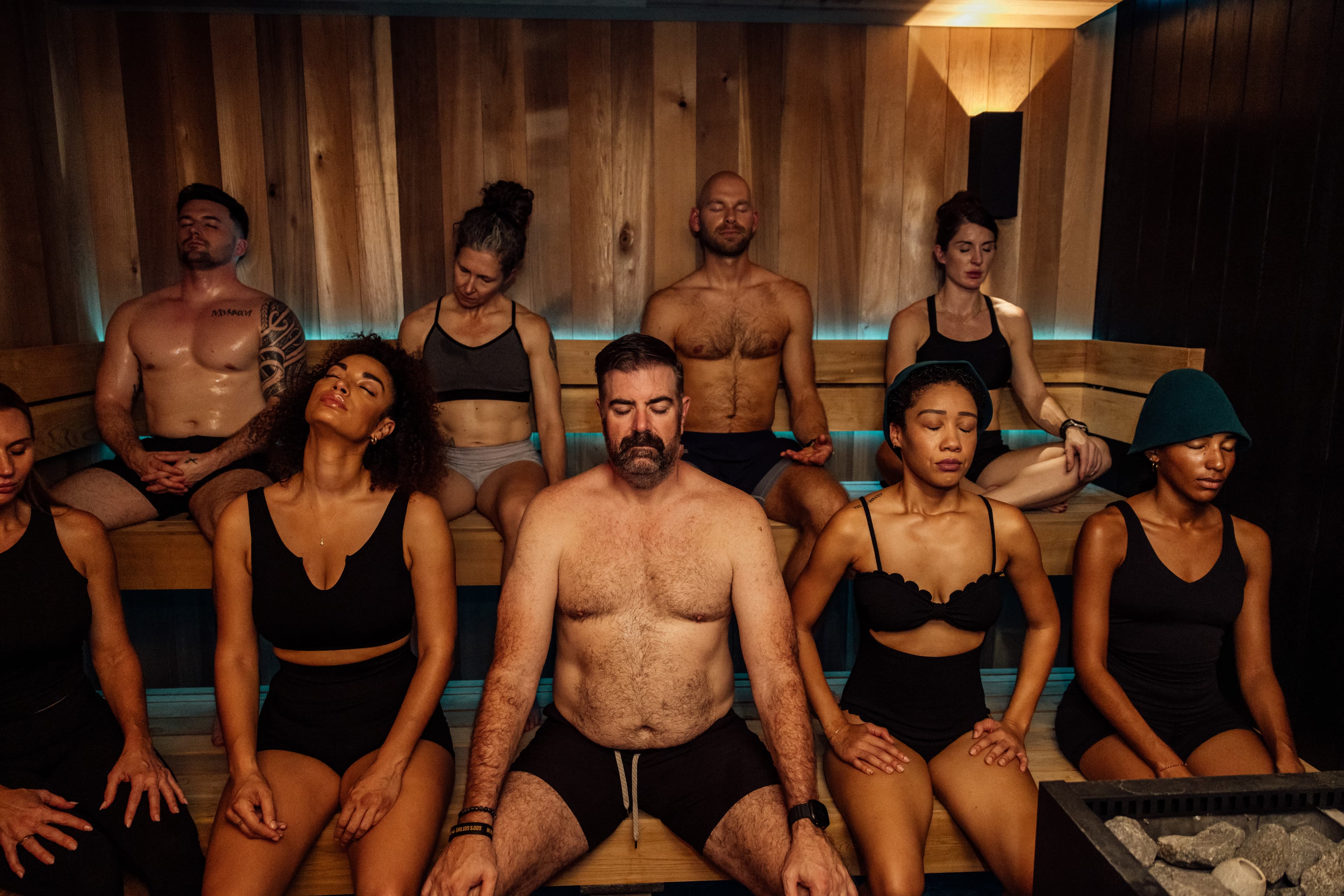
Most people know what a trigger is — a sound, a smell, a tone of voice that drops the body into fight-or-flight before the thinking mind has a say. Far fewer people know that triggers have an opposite. The therapist Deb Dana named it: a glimmer, a micro-moment that cues the nervous system that it’s safe, that it can soften, that it can come back to connection. Guided contrast therapy is, in a sense, a room engineered to produce them.
This is one of the ideas that sits underneath the Revivery Method, and it explains why a sauna and cold plunge session so often lands as something deeper than a workout. Here’s what a glimmer actually is, what the science of safety says about it, and why the heat and the cold are unusually good at surfacing them.
What is a glimmer?
A glimmer is the opposite of a trigger. Where a trigger pushes the body toward defense, a glimmer is a small cue — the warmth on your skin, a steady voice, the face of someone breathing with you — that nudges the body back toward calm and connection. Deb Dana, the clinician who coined the term and author of Anchored: How to Befriend Your Nervous System, describes glimmers as the moments that build our capacity to stay steady when life gets hard.
The idea grows out of polyvagal theory, developed by Stephen Porges, one of the thinkers the Revivery curriculum draws on. Porges’ framework centers on neuroception — the nervous system’s constant, below-conscious reading of cues of safety and danger. A glimmer is simply a cue of safety that registers. You don’t have to decide to feel calmer; the body does it first, and you notice after.
Why does contrast therapy create glimmers?
It sounds backwards. A hot sauna and a cold plunge or ice bath are stressors — deliberate discomfort. So why would they generate cues of safety rather than alarm? Because a well-led session pairs a real challenge with unmistakable signals that you’re held: a regulated instructor, a group breathing together, a container you can trust. The body meets something hard and, at the same moment, learns it can be hard and safe.
The physiology cooperates. Cold water immersion has been shown to produce a measurable lift in mood and a shift toward feeling active and alert, and brief cold exposure is associated with lower perceived stress over time. Those aren’t just biochemical footnotes — they’re the felt sense of a glimmer arriving. The plunge ends, the breath settles, and for a moment the whole system reports: I’m okay.
“I have a better understanding of what’s happening in my body, mind, and breath. I started choosing my reaction with curiosity and openness.”
How do you learn to notice glimmers?
Glimmers are quiet by nature — easy to miss if nobody points you toward them. Part of what a trained instructor does is direct attention: to the exhale that turns the cold from a threat into something manageable, to the warmth spreading back into the hands, to the small surprise of doing a hard thing in a room full of strangers who are cheering you on. Naming those moments is how a fleeting sensation becomes a skill you can carry out of the room.
That transfer — from the sauna bench to the rest of a life — is the whole point. Revivery co-founder Annette Scott frames the practice this way:
“We’re guided by SPIRE, because how you are in the sauna and how you are in the cold relates to how you manage difficulty in other parts of your life.”
Learn to find the glimmer inside a 40°F plunge, and you’ve rehearsed finding one inside a hard conversation, a hard day, a hard season. This is what graduates mean when they say the practice changes how they see.
“Everything that you learn within this training is so impactful in everything you do in your life. It changes the lens you’re viewing the world through.”
Why the group is part of the medicine
Some of the most reliable cues of safety are other people. In polyvagal terms, a calm face and a warm voice are among the strongest signals a nervous system can receive — which is exactly why guided contrast therapy is done together rather than alone. It also answers a need the culture keeps naming: the U.S. Surgeon General’s 2023 advisory on loneliness and isolation framed social connection as a genuine public-health issue. A room full of people finding glimmers together is a small, direct answer to that.
This is the heart of the Bio/Psych/Social Method: the sauna and the cold are the capsule, and connection is the medicine. The heat and cold create the opening; a skilled instructor and a supportive group turn that opening into a glimmer worth keeping.
The short version
A glimmer is the opposite of a trigger — a cue that tells your nervous system you’re safe. Guided contrast therapy pairs real challenge with real signals of safety, which is why a sauna and cold plunge session so often produces them. Noticing glimmers is a teachable skill, and instructors are trained to help a room find them. Learn to do it in the heat and the cold, and you can do it far beyond the studio.
Learn to guide the nervous system
REV-1 teaches the science of safety, the facilitation craft, and the method behind guided contrast therapy. REV-1 Foundations online + 3 days in Tampa. 30 CrossFit CEUs.
Choose Your REV-1 DatesThis article is educational and isn’t medical or psychological advice. Glimmers and polyvagal theory are frameworks drawn from the work of Deb Dana and Stephen Porges. Instructor quotes are from RIT graduate surveys and interviews, lightly edited for clarity.