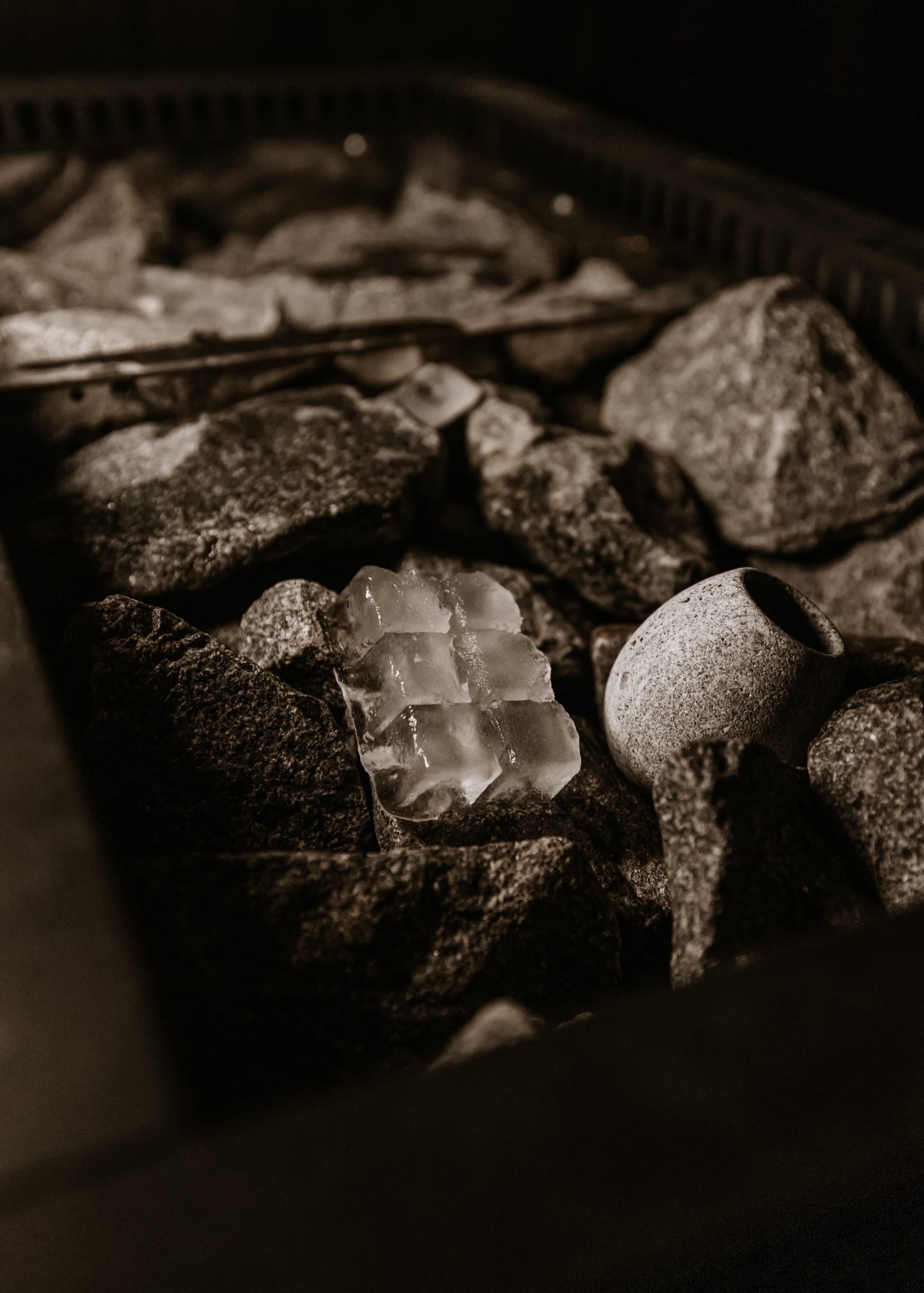
Step into a sauna and your body starts working within seconds. Sweat beads on your skin, your blood vessels widen, and your heart begins to beat faster. According to Cleveland Clinic, the physical response to sitting in the heat can mimic moderate exercise — your heart rate climbs, your circulation shifts, and your body releases anti-inflammatory agents. Nothing about the room is calm, even when you are.
That’s the paradox at the center of contrast therapy: you sit still and your physiology goes to work. Here’s what actually happens inside your body during a sauna session, why the dose matters, and why — at Revivery — we treat the heat as only half the practice.
What happens to your body in a sauna?
When your core temperature rises, your body has one job: shed heat to protect itself. Blood vessels near the skin dilate, your heart pumps harder to move warm blood to the surface, and sweat glands open to cool you by evaporation. Cleveland Clinic notes your heart rate can rise by roughly 30% in the heat — which is why the cardiovascular load resembles a brisk walk even though you’re sitting down.
This is the engine behind the research on sauna and the heart. The large Finnish cohort studies link frequent sauna use to lower all-cause mortality and to improved cardiovascular health, and the leading explanation is that repeated, well-dosed heat stress trains the cardiovascular system the way exercise does. The key words are repeated and well-dosed — a single hot afternoon isn’t the point; the practice is.
“I have a better understanding of what’s happening in my body, mind, and breath. I started choosing my reaction with curiosity and openness.”
How hot should a sauna be, and how long should you stay?
Traditional saunas typically run between 150 and 195°F. In our guided sessions we work in the range of 174–194°F, with heat rounds of roughly 8 to 11 minutes — long enough to drive a real physiological response, short enough to keep the dose appropriate for a room of people with different capacities. Cleveland Clinic’s general guidance for sauna-goers is similar in spirit: keep sessions to about 15 to 20 minutes, and if you’re new, start shorter and build.
Hotter and longer is not better. The heat is a stressor, and the benefit comes from applying it at a dose your body can adapt to, then recovering — often by pairing it with cold, such as a plunge or ice bath, the contrast that gives contrast therapy its name. That’s also why hydration is non-negotiable: a sauna moves real fluid, so we hydrate rooms with water and electrolytes before, during, and after, and we keep alcohol out of the equation entirely.
What are heat shock proteins, and why do they matter?
One of the more interesting things heat does is molecular. When cells are heated, they ramp up production of heat shock proteins — molecular chaperones that help repair and refold damaged proteins and protect cells from future stress. The Mayo Clinic Proceedings review of sauna science points to this cytoprotective response, alongside cardiovascular and neuroendocrine effects, as part of why regular heat exposure appears to be good for long-term health.
It’s a useful example of a bigger principle: a controlled, recoverable stressor can leave the system more resilient than it was before. The body doesn’t just survive the heat — it adapts to it. That same principle, applied to the nervous system rather than the cells, is the heart of what we teach instructors.
Why the heat brings people’s barriers down
Something happens in a hot room that protocol sheets don’t capture. People who arrived guarded soften. Conversations go deeper than anyone expected. Our certified instructors see it constantly.
“People cry over how profound and intense the experience is — especially when they didn’t expect it. The heat puts their barriers down.”
That’s the bridge from biology to everything else. The heat is a shared, embodied stressor, and moving through it alongside other people lowers defenses in a way that ordinary conversation rarely does. It’s why we hold that the sauna and the cold are the capsule, and connection is the medicine — the thermal science opens the door, and what walks through it is human.
“We’re guided by SPIRE, because how you are in the sauna and how you are in the cold relates to how you manage difficulty in other parts of your life.”
This is the difference between a hot box and a guided session. A thermostat can deliver the biological stimulus. Only a trained person can hold the room so that the experience becomes meaningful and safe — which is exactly what the Bio/Psych/Social Method is built to teach.
The short version
Heat makes your heart work like light exercise, opens your blood vessels, and triggers a protective heat-shock response that, repeated over time, appears to be good for your cardiovascular health. Real heat, well-dosed — around 174–194°F in 8 to 11 minute rounds — hydrated, alcohol-free, and recovered with cold. And the most powerful part isn’t on the thermometer: it’s what the heat opens up when people move through it together.
Learn the science, lead the room
REV-1 teaches the physiology of heat and cold, the safety protocols, and the facilitation craft of guided contrast therapy. REV-1 Foundations online + 3 days in Tampa. 30 CrossFit CEUs.
Choose Your REV-1 DatesThis article is educational and isn’t medical advice. Saunas aren’t right for everyone — Cleveland Clinic and Harvard Health advise checking with your doctor first if you have heart conditions, high or low blood pressure, are pregnant, or are taking medication. If you have a health condition, talk with your doctor before starting a sauna or cold plunge practice. Instructor quotes are from RIT graduate surveys and interviews, lightly edited for clarity.