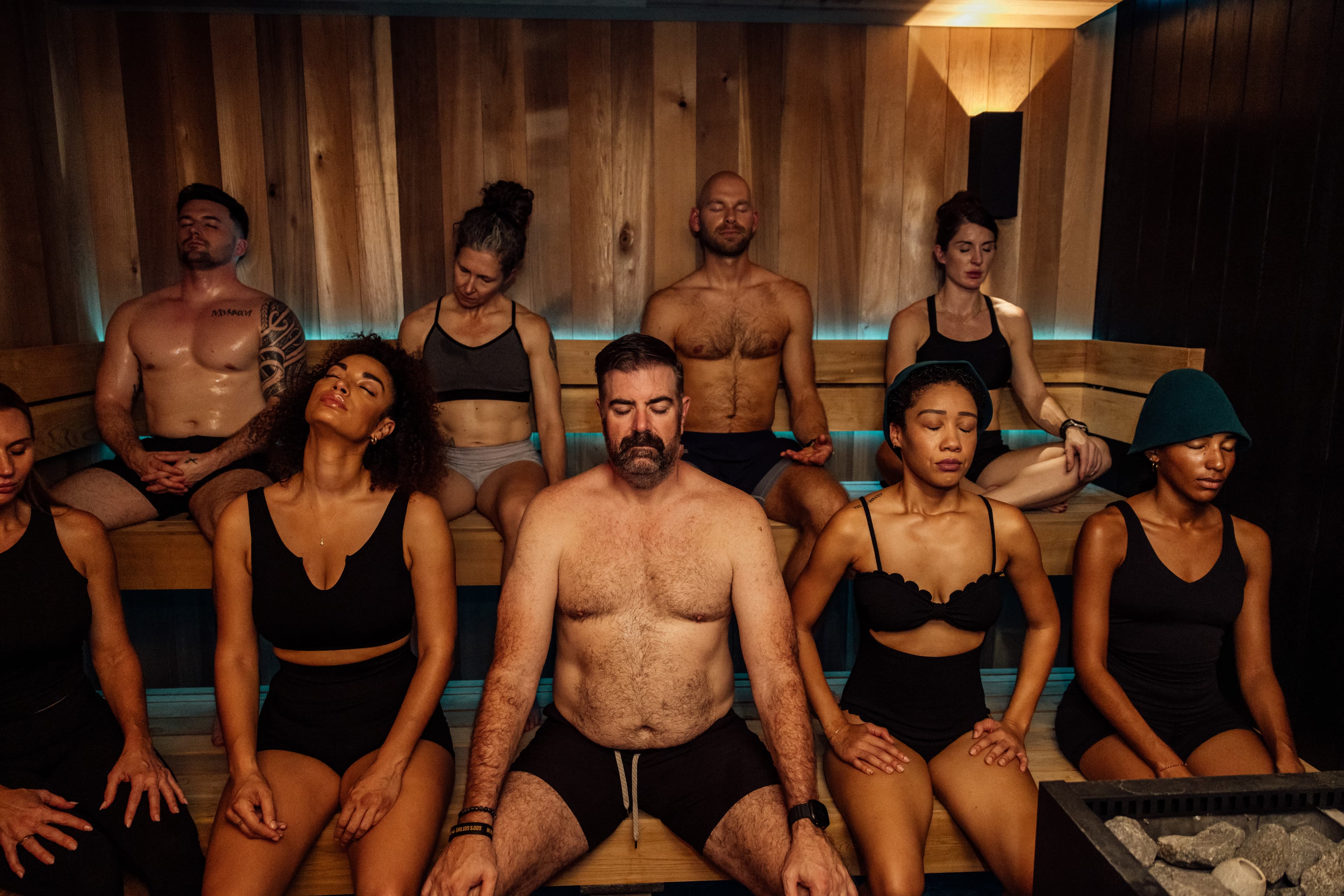
You’ve probably seen the two halves of it by now: a sauna hot enough to make you want to leave, and a cold plunge cold enough to make you gasp. Put them together, on purpose, and you have contrast therapy — one of the fastest-growing practices in wellness. The global sauna market alone is measured in the billions of dollars, and cold plunge tubs have gone from fringe biohacking gear to backyard fixtures. But most of that growth is happening solo — one person, a timer, and a phone. Guided contrast therapy is a different thing entirely. This is what it means, and why the guidance is the part that matters.
What is contrast therapy?
Contrast therapy is the deliberate alternation of heat and cold — most often a hot sauna followed by a cold plunge or ice bath, repeated across a session. The mechanism is circulatory. Heat opens your blood vessels (vasodilation); cold clamps them down (vasoconstriction). Cycling between the two creates what researchers describe as a vascular pumping effect — your circulatory system doing intervals. It’s an old idea, used for athletic recovery for decades. A 2013 systematic review and meta-analysis in PLoS ONE found that contrast water therapy reduced muscle soreness after exercise compared with simply resting — though it was no clear winner over other recovery methods, which is worth being honest about.
The individual halves are better studied than the combination. Regular sauna use is linked in large Finnish cohort studies to lower all-cause mortality and better cardiovascular outcomes. Cold water immersion has been associated with improvements in mood and a sense of alertness. So the science is real, and it’s also still maturing — which is exactly why how you practice, and who’s in the room, ends up mattering as much as the temperatures.
What makes it “guided”?
Solo contrast therapy is you, the heat, the cold, and your own willpower. Guided contrast therapy adds two things: a group, and a trained person leading it. At Revivery, a session is a small group moving through structured rounds of heat and cold together, led by a certified instructor who sets the pace, coaches the breath, watches the room, and holds the emotional container the whole way through.
That last part isn’t decoration. The riskiest moment in any session is the first few seconds of cold, when sudden skin cooling triggers the cold shock response — an involuntary gasp, a spike in heart rate, and fast, hard-to-control breathing. An instructor who knows to coach a long, slow exhale before entry turns that from something you brace against into something you can work with. The guidance is, quite literally, physiological.
“We are showing people how to use these tools—sauna and cold plunge—to come into community.”
That word — community — is the tell. The heat and the cold could be done at home. What can’t be done at home is a room of strangers going through something hard together, witnessed and led by someone whose only job is to keep everyone safe, encouraged, and present.
Why do a hard thing in a group?
Because doing a hard thing held is a fundamentally different experience than doing it alone. The U.S. Surgeon General’s 2023 advisory on loneliness and isolation named social disconnection a public-health crisis with mortality risk comparable to smoking. Guided contrast therapy is, among other things, a structured excuse to be in a room with other people, doing something real. Graduates of our training describe watching that land for people who didn’t come looking for it.
“To be able to come into a setting with total strangers and open up and talk about really deep, profound things is a way to heal that I’ve never experienced before. I knew nobody in that room.”
This is the heart of how Revivery thinks about the practice: the sauna and the cold are the capsule, and connection is the medicine. The temperature does something to your body. The room does something to the rest of you.
The Bio/Psych/Social Method
Guided contrast therapy at Revivery runs on a framework we call the Bio/Psych/Social Method, and the name is the whole idea. There’s a biologicallayer — the thermal science of heat and cold, dosed safely. There’s a psychologicallayer — trauma-informed, nervous-system-aware facilitation that teaches people they can be uncomfortable and safe at the same time. And there’s a social layer — the community and connection that turn a workout into an experience people remember for years.
A trained instructor works all three at once. They’re what Revivery co-founder Annette Scott calls the competent protector — someone who keeps everyone safe but knows when to push, encourage, and guide. It’s a real skill, and it’s the thing that separates guided contrast therapy from a hot box next to a cold tub.
“To guide people, to be their competent protector, to hold space for somebody is a very powerful thing.”
The short version
Contrast therapy is deliberate heat then cold, alternated for a circulatory and mental effect. Guided contrast therapy adds a group and a trained instructor who dose it safely, coach the breath, and hold the room. The science of heat and cold is real and still growing; the reason to do it led, and in company, is that a hard thing done together is safer, deeper, and — for a lot of people — the first time they’ve felt genuinely connected in a long while.
Learn to lead the practice
REV-1 teaches the science, the safety protocols, and the facilitation craft behind guided contrast therapy. REV-1 Foundations online + 3 days in Tampa. 30 CrossFit CEUs.
Choose Your REV-1 DatesThis article is educational and isn’t medical advice. If you have a health condition, talk with your doctor before starting sauna or cold plunge practice. Instructor quotes are from RIT graduate surveys and interviews, lightly edited for clarity.