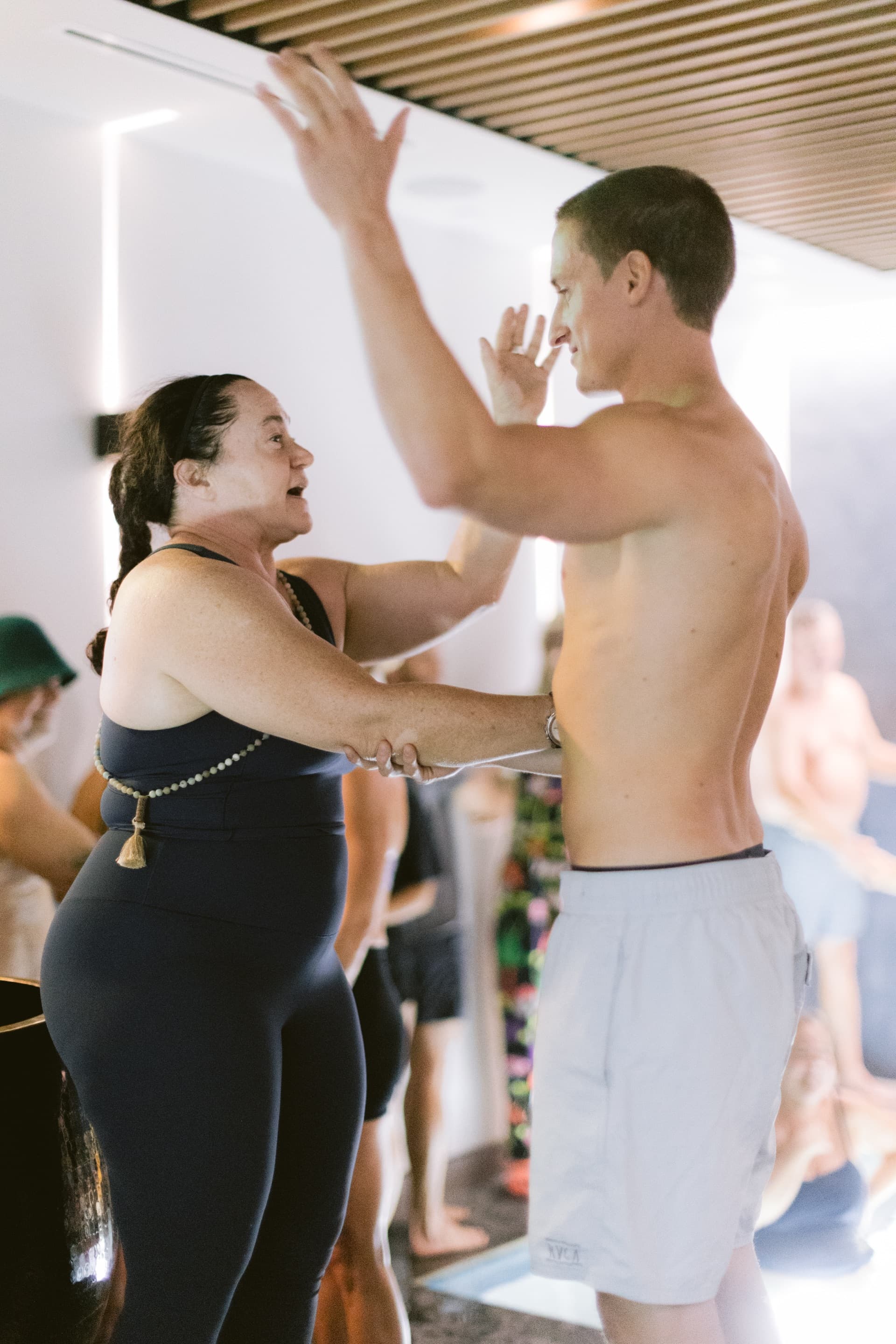
In 2023 the U.S. Surgeon General declared loneliness an epidemic, citing evidence that poor social connection is associated with a 29% increased risk of heart disease and a 32% increased risk of stroke — a health impact the advisory compared to smoking up to 15 cigarettes a day. Around the same time, sauna and cold plunge culture exploded. Most of it arrived as a solo pursuit: a barrel sauna in the backyard, an ice bath on the patio, headphones in, world out.
There’s nothing wrong with a solo practice. But if you’ve only ever done heat and cold alone, the research — and a few thousand people who’ve sat in a guided circle — suggest you’ve been getting a fraction of what the practice can do. Here’s why a small group, led well, may be the most powerful format in wellness.
What does social connection actually do to your body?
The evidence here is not soft. A landmark meta-analysis of 148 studies covering more than 308,000 people found that individuals with stronger social relationships had a 50% greater likelihood of survival over the study periods — an effect comparable to quitting smoking and larger than the effects of obesity or physical inactivity. The finding held across age, sex, health status, and cause of death.
Connection doesn’t just extend life; it changes how the nervous system processes stress in real time. In a well-known fMRI study, women anticipating an electric shock showed markedly reduced threat activity in the brain while holding their husband’s hand — and even a stranger’s hand attenuated the response. The brain treats trusted company as a resource, and it budgets stress accordingly. A hard thing done next to another person is, neurologically, a smaller hard thing.
Now put that inside a sauna. Contrast therapy is deliberate, controlled stress — that’s the point of it. Doing that stress in trusted company doesn’t soften the practice. It changes what your nervous system can do with it.
Is group exercise better than working out alone?
For stress and quality of life, the research says the group format itself carries weight. In a 12-week study of medical students, those who exercised in a weekly group class reported a 26% reduction in perceived stress and significant gains in mental, physical, and emotional quality of life. The students who worked out alone put in roughly twice the exercise time — and saw no significant change in stress at all. More effort, alone, produced less of what most people are actually seeking.
The same logic runs through guided contrast therapy. A cold plunge done solo builds grit. The same plunge done in a circle of people breathing through it together builds grit and something the solo version can’t: the lived experience of being uncomfortable, witnessed, and okay.
“To be able to come into a setting with total strangers and open up and talk about really deep, profound things is a way to heal that I’ve never experienced before. I knew nobody in that room.”
Why does a small group feel safer than a big class?
Size is not a detail. In a room of eight to twelve, every person is visible — to the instructor and to each other. There’s nowhere to disappear, and that turns out to be the feature, not the bug. Anonymity is what lets people stay armored. A small group is large enough that no one is under a spotlight, and small enough that no one is invisible.
The physiology backs this up in a very practical place: the plunge. Research shows that anxiety amplifies the cold shock response — the involuntary gasp and heart-rate spike of sudden cold immersion. A calm room lowers the anxiety, and the group is part of what makes the room calm: watching the person before you exhale and settle into an ice bath tells your nervous system, before any conscious thought, that this is survivable. Instructors see this nightly — the group literally makes the cold easier.
“While you are holding space for others to be vulnerable, they are also holding space for you.”
The instructor is what turns a group into a container
A small group alone isn’t magic. Eight strangers in a hot room with no one leading is just a crowded sauna. What converts a group into a container is a trained instructor — someone we call a competent protector — who holds the protocol, reads the room, and makes it safe for people to be uncomfortable without being in danger.
This is the heart of the Bio/Psych/Social Method: the biological stimulus of heat and cold, the psychological skill of guiding people through it, and the social field where the deepest change happens. Or as we say it at Revivery — the sauna and the cold are the capsule; connection is the medicine.
“We are showing people how to use these tools—sauna and cold plunge—to come into community.”
Strong medicine in a supported container. The heat drops people’s barriers, the cold proves something to them about themselves, and the circle is where both get put into words. One RIT-certified instructor described what that looks like from the front of the room: “People cry over how profound and intense the experience is — especially when they didn’t expect it. The heat puts their barriers down.”
The short version
Social connection is one of the strongest predictors of long-term health we know of. Company measurably reduces the brain’s threat response, and group formats outperform solo effort on stress even when the solo effort is doubled. A small group — big enough for belonging, small enough for attention — is the setting where contrast therapy does its deepest work. And the person leading the room is what makes all of it safe enough to matter.
Learn to lead the room
REV-1 teaches the science, the safety protocols, and the craft of guiding small group contrast therapy. REV-1 Foundations online + 3 days in Tampa. 30 CrossFit CEUs.
Choose Your REV-1 DatesThis article is educational and isn’t medical advice. If you have a health condition, talk with your doctor before starting sauna or cold plunge practice. Instructor and graduate quotes are from RIT graduate surveys, interviews, and testimonial recordings, lightly edited for clarity.