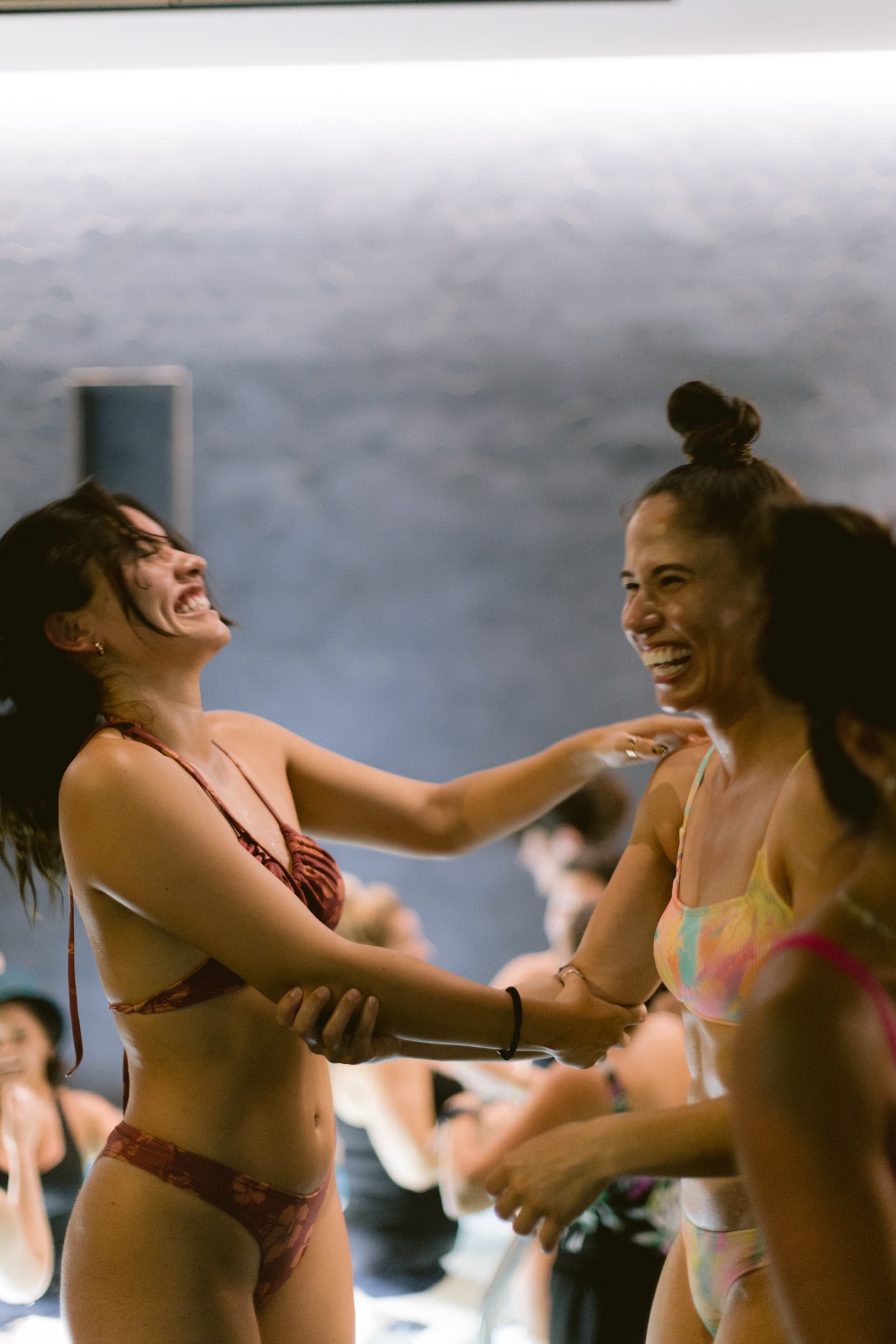
When researchers ran the Global Sauna Survey — an international study of regular sauna bathers published in Complementary Therapies in Medicine — the headline finding wasn’t about heart rate or heat shock proteins. It was that relaxation was the single most cited reason people sauna, and that 83.5% reported better sleep afterward, often lasting a night or two.
That tracks with what instructors hear at the end of a guided session. Almost nobody walks out of the room talking about physiology. They talk about how they feel, what surprised them, and — surprisingly often — about the strangers they just sat next to. Here’s what people actually say after a guided sauna and cold plunge session, and what the research says is behind each one.
How do you feel right after a sauna and cold plunge session?
The most common first sentence is some version of “I feel amazing, and I have no idea why.” People describe feeling clear-headed, physically light, wide awake but not wired, and oddly calm about things that were stressing them out an hour earlier.
That description lines up closely with what a 2023 brain-imaging study found. After a five-minute head-out cold-water immersion, participants reported increases in positive affect — feeling more active, alert, attentive, proud, and inspired — alongside reductions in distress and nervousness, with matching changes in connectivity between the brain networks that handle emotion and attention. The “I feel amazing” isn’t imagination. It has a measurable signature.
The word people reach for most is clear. Not relaxed, not energized — clear. Deliberate heat followed by deliberate cold seems to leave people with less noise in their heads than they came in with.
Why do people cry in the sauna?
It happens more than newcomers expect, and it catches people off guard. Someone who came for recovery ends up talking about a divorce, a diagnosis, or a parent. Instructors see it constantly.
“People cry over how profound and intense the experience is — especially when they didn’t expect it. The heat puts their barriers down.”
There’s no mystery in why this happens. Heat makes small talk hard. You can’t multitask in a 190°F room, you can’t check your phone, and holding a polished version of yourself together takes energy the body would rather spend on thermoregulation. What’s left is a group of people sitting still, breathing audibly, with nothing to do but be present. That is an unusually honest set of conditions, and honesty tends to follow.
Worth saying plainly: this is not therapy, and a good instructor doesn’t pretend otherwise. The job is to hold the room steady when something real surfaces — not to fix it. One graduate named the hardest part of learning that skill: “The biggest challenge is stepping away from the ‘I have something to fix your problems’ approach.”
Does a cold plunge actually change your mood?
Ask anyone climbing out of an ice bath and the answer arrives before they can articulate it — usually a laugh, then something like “okay, that was incredible.” The mood lift after cold immersion is one of the most reliably reported effects in the whole practice, and it’s well documented in the research on cold water and the nervous system.
But the sentence people say most often isn’t about mood at all. It’s “I didn’t think I could do that.” The plunge is a small, contained, fully survivable hard thing with a clear finish line — and finishing it tells you something about yourself that no amount of encouragement can. Instructors describe watching that land in real time.
“He listened to my cues and was fully present. He was so proud of himself, smiling like a little kid even thirty minutes later. I love leading brand-new people through the heat and the cold and witnessing their astonishment that they can do hard things.”
It also gets easier, which people notice by their second or third session and often mention out loud. Repeated cold exposure substantially blunts the cold shock response — the involuntary gasp and heart-rate spike of sudden immersion. Your body genuinely learns the cold. Feeling that adaptation happen in your own nervous system is, for a lot of people, the first concrete proof that they can recalibrate to hard things.
Why do people sleep better after a sauna?
“I slept like a rock” is the most common next-day message instructors get. It’s also the survey finding above: 83.5% of sauna bathers reported improved sleep, with the benefit typically lasting one to two nights.
The likely mechanism is straightforward. Sauna raises core body temperature; afterward, it falls — and a falling core temperature is one of the body’s standard cues that it’s time to sleep. Add a session’s worth of cardiovascular load — heart rates in a hot sauna climb into moderate-exercise territory — and the sleep pressure that follows makes sense.
Why do strangers open up to each other in a sauna circle?
This is the thing first-timers say that surprises them most: they came alone and left feeling like they knew people. In a country where the U.S. Surgeon General has called loneliness an epidemic, an hour that reliably produces that feeling is not a small thing.
“To be able to come into a setting with total strangers and open up and talk about really deep, profound things is a way to heal that I’ve never experienced before. I knew nobody in that room.”
Part of it is that doing the hard part together changes the hard part. Research on shared experience found that simply undergoing an experience at the same time as another person amplifies it, even with no conversation at all — pleasant experiences felt more pleasant, unpleasant ones more intense. A cold plunge taken beside seven other people isn’t the same event as a cold plunge taken alone, and neither is the relief afterward.
“While you are holding space for others to be vulnerable, they are also holding space for you.”
What do people say weeks later?
The immediate reactions are loud. The durable ones are quieter, and they’re about how someone handles ordinary difficulty — a hard conversation, a bad morning, a long wait. People report being steadier. Graduates who now lead sessions describe the same shift in themselves.
“I feel like I see things differently. I’m much more patient. I am much more present, more understanding, and I assume positive intention from people first.”
That’s the whole premise, and it’s the reason the practice is guided rather than freestyle. As Revivery co-founder Annette Scott puts it, the sauna and the cold aren’t the lesson — they’re the classroom.
“We’re guided by SPIRE, because how you are in the sauna and how you are in the cold relates to how you manage difficulty in other parts of your life.”
Why the guide is the part people can’t name
Here’s the pattern worth noticing in all of it: people rarely credit the instructor. They say the heat was incredible, the plunge was incredible, the group was incredible. What they’re describing is a room that was paced correctly, watched carefully, and held by someone who knew what to do when it got quiet — a competent protector. Done well, that work is invisible. That’s the point.
It’s also what the Bio/Psych/Social Method is built to teach: the biology of heat and cold, the psychology of guiding people through discomfort, and the social field where the lasting part happens. The sauna and the cold are the capsule; connection is the medicine. Strong medicine in a supported container.
“They will gain the ability to teach people that even when they are uncomfortable, they are still safe, capable, and can still problem solve.”
The short version
People come out of a guided contrast therapy session saying they feel clear, that they slept better, that they didn’t think they could do the cold, and that they talked to people they’d never met about things they don’t usually say out loud. Each of those has research behind it. None of them happen as reliably without someone leading the room.
Learn to lead the room
REV-1 teaches the science, the safety protocols, and the craft of guiding small group contrast therapy. REV-1 Foundations online + 3 days in Tampa. 30 CrossFit CEUs.
Choose Your REV-1 DatesThis article is educational and isn’t medical advice, and a guided contrast therapy session is not therapy or mental health treatment. If you have a health condition, are pregnant, or take medication that affects blood pressure or heat tolerance, talk with your doctor before starting sauna or cold plunge practice. Instructor and graduate quotes are from RIT graduate surveys, interviews, and testimonial recordings, lightly edited for clarity; participant reactions are described from instructor accounts rather than quoted directly.