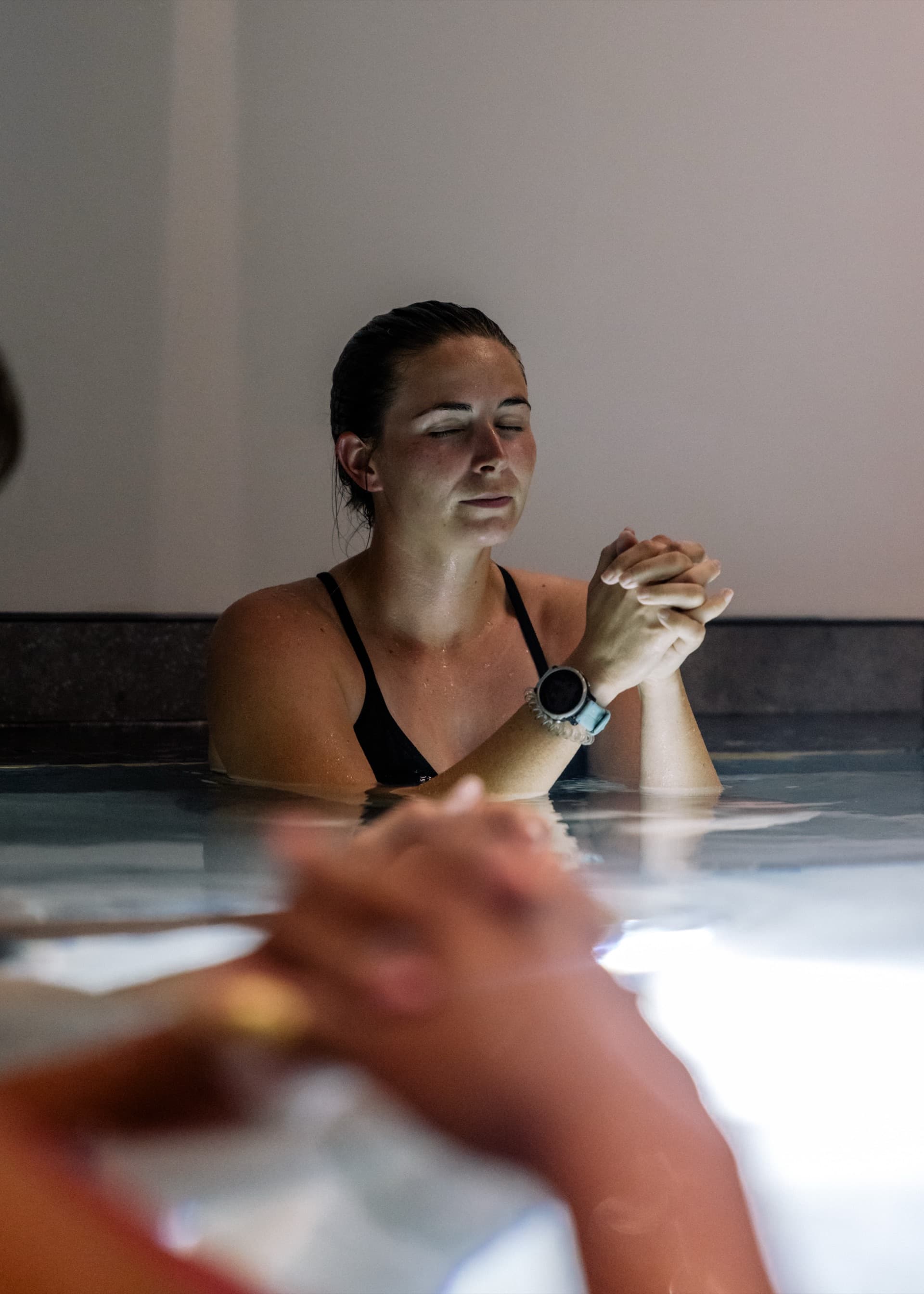
In 2007, researchers in Germany ran an unusual experiment. They took 18 psychotherapists in training, randomly assigned half of them to a daily meditation practice, and then tracked what happened to their patients — 124 of them, none of whom knew which therapists were meditating. The result: patients treated by the practicing therapists improved significantly more across measures of anxiety, hostility, and overall symptom load. The patients never sat on a cushion. Their therapists did, and it showed up in the patients’ outcomes.
That finding is the clearest version of a principle every good sauna and cold plunge instructor eventually learns: the state of the person leading the room transfers to the room. You can’t guide people through heat and cold you’ve stopped visiting yourself. Here’s why a personal practice isn’t a nice-to-have for instructors — it’s the job.
Why do sauna and cold plunge instructors need their own practice?
The short answer is that an instructor’s most important tool isn’t the thermostat or the timer — it’s their own nervous system. A guided session works because a regulated person is holding the room, and people can read that regulation whether or not they can name it. A calm, steady presence beside the plunge changes what the plunge feels like.
The research backs the intuition in a specific way: state is contagious around cold water. A study of anxiety and cold immersion found that raising a person’s anxiety before an immersion measurably amplified their cold shock response — a bigger gasp, a higher heart-rate spike — even in people whose bodies had already adapted to the cold. Anxiety undoes adaptation. An instructor who walks in carrying their own unexamined stress isn’t neutral; they’re an input. The only reliable way to bring a settled nervous system to work is to keep training it.
“I have a better understanding of what’s happening in my body, mind, and breath. I started choosing my reaction with curiosity and openness.”
Does cold exposure get easier the more you do it?
Yes — measurably, and fast. Repeated immersion substantially blunts the cold shock response after as few as five or six short exposures: the involuntary gasp shrinks, the heart-rate spike flattens, and the panic edge comes off. An instructor with a live ice bath practice knows this adaptation from the inside — what minute two feels like, where the urge to bolt lives, how the breath changes when the body finally accepts the cold.
That firsthand knowledge is the difference between coaching and reciting. When you tell a first-timer “the gasp passes in about thirty seconds,” you’re either reporting from your own body or repeating something you read. People can tell which. The same is true of the heat — knowing from experience what a 190°F room does to a heart rate changes how you pace one.
Does training in the cold help with other kinds of stress?
This is where the research gets striking. Physiologists call it cross-adaptation: training your response to one stressor improves your response to a different one. In a study published in the Journal of Physiology, participants who habituated to six five-minute cold-water immersions showed a calmer physiological response to an entirely unrelated stressor — low oxygen — days later. The cold didn’t just teach their bodies about cold. It turned down the whole alarm system.
For an instructor, that’s the deeper case for practice. The plunge is a rehearsal space for every difficult moment the job contains — the participant who panics, the room that goes heavy, the session where nothing lands. An instructor who regularly practices staying calm in genuinely uncomfortable conditions is doing reps for the moments when someone else’s discomfort is the thing that needs holding.
“We’re guided by SPIRE, because how you are in the sauna and how you are in the cold relates to how you manage difficulty in other parts of your life.”
What does a personal contrast therapy practice look like?
It doesn’t need to be heroic. The same protocol ranges that govern a guided session govern a personal one: sauna in the 174–194°F range for rounds of 8–11 minutes, cold water between 38–55°F for up to 3 minutes, hydration and electrolytes, never after alcohol. Consistency matters more than intensity — the long-running Finnish cohort research found that the cardiovascular benefits of sauna scaled with how often people went, not with how much they suffered per visit.
What separates an instructor’s practice from a casual one is attention. A practice session is where you study your own responses — where the resistance shows up, what your breath does at minute nine, which days the cold feels like a wall. That self-knowledge becomes the raw material for reading other people. It’s hard to notice a participant quietly white-knuckling the plunge if you’ve never watched yourself do it.
“Everything that you learn within this training is so impactful in everything you do in your life. It changes the lens you’re viewing the world through.”
Can you lead a room you’ve stopped sitting in?
Technically, yes — for a while. The protocol still runs, the timer still works. But the qualities that make a session worth guiding — attunement, credibility, the settled presence a nervous system can read — all decay without maintenance. Teaching draws the practice down; practice fills it back up. Every tradition that trains people to hold space for others, from psychotherapy to meditation teaching, has landed on the same rule: the guide keeps practicing.
That’s why the Bio/Psych/Social Method treats an instructor’s personal practice as part of the curriculum rather than an assumption. REV-1 puts every trainee through the full experience repeatedly before they ever lead it, and REV-2 builds ongoing practice and peer accountability into its six-week structure — because the sauna and the cold are the capsule, connection is the medicine, and the instructor’s own practice is what keeps the capsule safe to open.
“Those of us that get called to come here — you obviously have something in you that is meant to be shared.”
The short version
Your practice is not separate from your teaching — it’s the source of it. The research says a practitioner’s inner training shows up in the people they work with, that anxiety is contagious around cold water, and that regularly meeting a hard thing on purpose steadies your response to hard things in general. An instructor who keeps sitting in the heat and getting in the ice bath isn’t indulging a hobby. They’re maintaining the instrument.
Build a practice worth teaching from
REV-1 teaches the science, the safety protocols, and the craft of guiding small group contrast therapy — starting with your own practice. REV-1 Foundations online + 3 days in Tampa. 30 CrossFit CEUs.
Choose Your REV-1 DatesThis article is educational and isn’t medical advice. If you have a health condition, are pregnant, or take medication that affects blood pressure or heat tolerance, talk with your doctor before starting a sauna or cold plunge practice. Graduate and instructor quotes are from RIT graduate surveys, interviews, and testimonial recordings, lightly edited for clarity.